This October's Steam Next Fest is the largest so far. Coverage puts it at 7,000+ projects (some counts go past 8,000), close to double June's event. Kotaku found many of them openly saying in their AI disclosures that large parts of their code and art were generated. GamesRadar described a lot of them as vibe-coded clones of existing games/ideas. Steam users are struggling to find anything in the list. More developers decide not to publish a demo to avoid the risks.
The Needle in a Haystack situation
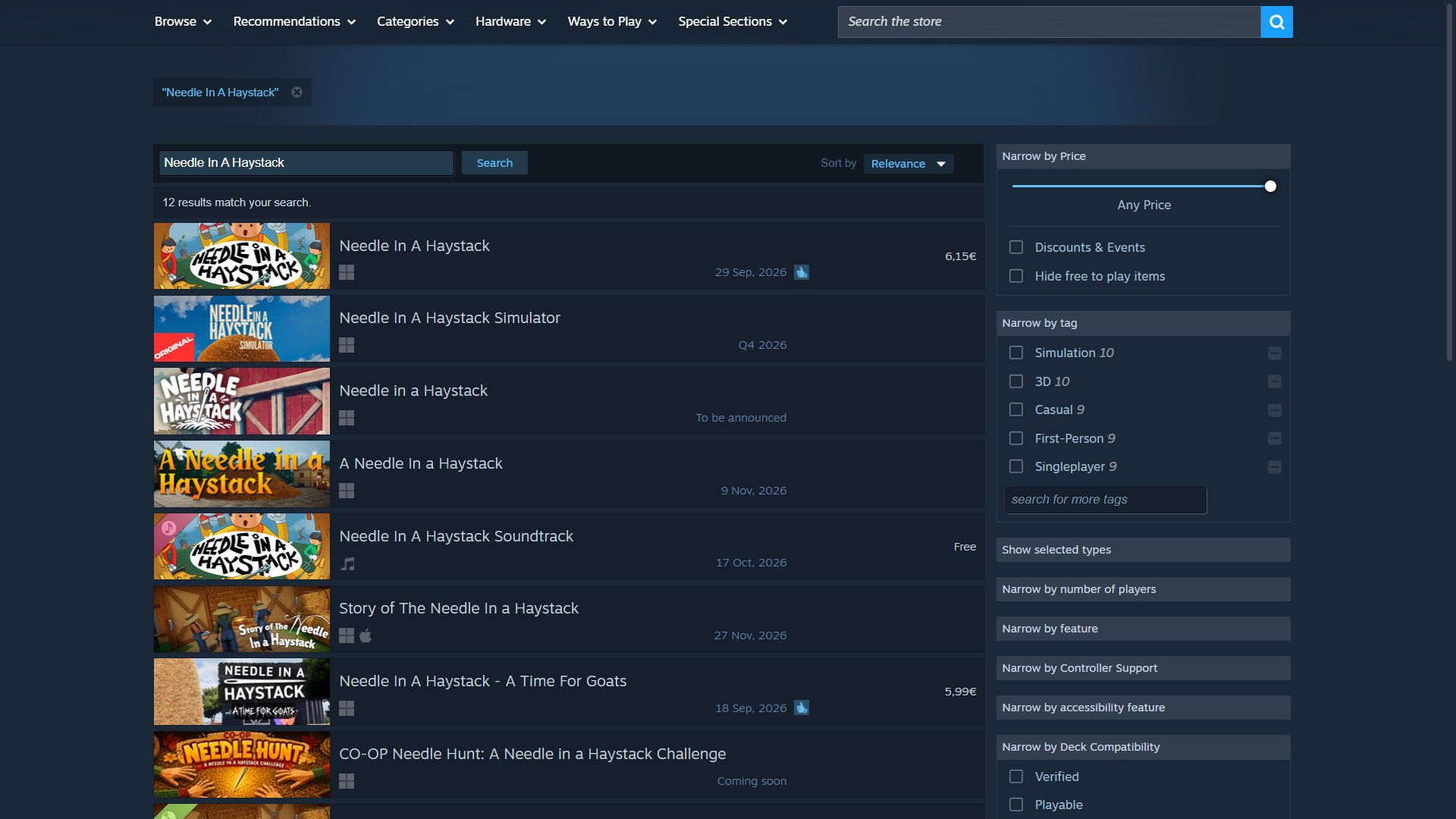
In August, Needle In A Haystack Simulator (by Studio Bitdot) went viral. Within weeks Steam had a pile of games with nearly the same name and everything (Kotaku counted at least 14).
One of them is Needle In A Haystack by NoGlyph, released on September 29. On October 17, NoGlyph posted on Steam that another one, A Game About Needle In A Haystack by Little Field Studios (released October 16), contains their code. According to NoGlyph:
- The game's
Assembly-CSharp.dllcontains a namespace calledNeedlefield.ReferenceHaywith 13 of their classes under the same names (e.g.,HayDomeRendererandHayExcavationCollider). - 1/2+ the methods in that part match theirs (their lead developer later put it at 39 identical methods).
- Their error messages are in it word for word, including one that names a shader from their project (
Needle in a Haystack/Hay Dome Procedural) that doesn't exist in the other game. - The copied code matches their demo builds from September 20 and 21.
People are actively talking about this and pointing out the irony (clone complaining about being cloned).
Copying got cheap
How hard a game is to deconstruct depends on what's inside the builds. That mostly comes down to the engine and how it cooks/compiles your project.
Unity with Mono ships your C# compiled to IL in Assembly-CSharp.dll. Free decompilers (ILSpy/dnSpy) turn it back into readable C# instantly (with your names/strings intact). The accused game in this story is a Mono build, which is how NoGlyph could open it and find their own namespace.
Unity with IL2CPP compiles your C# to native code (GameAssembly.dll on Windows, and libil2cpp.so on Android). That's harder to read than Mono (but less of a wall than many developers assume). Unity ships a metadata file (global-metadata.dat) next to the code, holding the name of every class/method/field in your game and every string literal. Open-source tools like Il2CppDumper read it and give back your full class list with the address of each method in the binary (usually within minutes). The native code then goes into a decompiler like Ghidra or IDA.
Godot packs your scenes/resources/scripts into a .pck file (or into the executable itself). GDScript ships as text or in a compiled form that converts back. Free tools like Godot RE Tools rebuild an editable project from it. Godot can encrypt the .pck, but the key is compiled into the game (it can be pulled back out). C# in Godot ships as .NET assemblies, which decompile the same way Unity's Mono builds do.
Other engines vary. GameMaker's default export keeps your compiled code in data.win. Tools like UndertaleModTool decompile it back to GML (the YYC export compiles to native code instead). Unreal compiles C++ to native code, but its reflection system keeps many class/function/property names in the game. Free tools dump them from a running game into ready-made headers.
Where AI comes in
Reading (let alone modifying) decompiled code used to be slow and required actual time/effort. Turning native code from Ghidra or IDA back into something you could reuse took an experienced person a long time. Unfortunately, current LLMs read it quickly and can rewrite it as a readable source, especially when every function already has its original name. Kotaku called the pattern in this case a telltale sign of AI-assisted decompilation.
Another type of cloning
We notice cases where clones don't touch a build. Someone sees a trailer or a viral clip/post and asks an AI agent for "a game like this". That works for simple games. Ideas and mechanics generally aren't protected by copyright, so doing anything with the project, unfortunately, doesn't help against this. Fortunately, anything bigger needs a person steering the AI, plus real time and effort, so this path remains less attractive.
What might happen next to the industry
These are our guesses/predictions (+/- in order of how likely we think they are).
Fewer public demos
Already started. On October 17, YNOT (the 2-person team behind Spookitchen) pulled its public demo after hearing that someone was cloning their game with AI and called it a temporary measure. The studio behind Moonlighter said it won't run a public playtest of its next game because of AI-led cloning concerns.
We expect to see more of:
- playtests gated behind keys/sign-ups
- shorter demos (less of the game in them)
- demos released close to launch (less time to get a copy out first)
Trailers/announcements show less
If a trailer is enough to start a clone, some developers will show less gameplay before launch and keep the time between announcement and release short.
Platforms push back
Valve has had developers disclose AI use on store pages since January 2024. Users are now asking for a filter that hides AI slop. For copied code, takedowns are still the main remedy, but they're slow. By the time one goes through, the launch window a clone was aiming for has often passed.
Protection becomes a normal build step
Any software that distribute a public build will start treating some form of compile-time code mutation and general protection as a normal part of shipping. For Unity that means IL2CPP rather than Mono, with the metadata/assets encrypted and the most sensitive code virtualized, on every build that leaves the studio (demos and playtests included).
Streaming demos and server-side logic
A software running on a server and streaming video to the user never puts the build on the player's machine (there's nothing to decompile). The same applies to online games that keep their logic on the server. Both cost money for every hour played and add input latency. They suit some games (short demos/online games that run servers anyway) better than a $10 single-player game (we'd expect them for high-profile demos first).
Some software might go open source
Some developers will decide hiding their code isn't worth it. They'll publish it and compete on what can't be copied overnight (updates/community/the name players already know). That can work, especially for games built around modding. For a small paid game racing a wave of clones, it hands every cloner a clean copy on day one. An open source license can still be enforced, but through the same slow takedown process as anything else.
For players: telling the original from a clone
- Compare the developer and publisher on the store page with the game's own website or social accounts. Clones usually have a near-identical name/different developer.
- Check the release date. A game that showed up a few weeks after a viral clip (from a studio nobody has heard of) deserves a closer look.
- Read the AI disclosure section on the Steam page. It's self-reported (doesn't have to cover everything), but many Next Fest games openly list AI use there.
- Follow or wishlist the game from the developer's own links instead of the search results.
- If you bought the wrong one, Steam will usually refund a game within 14 days of purchase if you've played it for less than 2 hours.
- Keep playing the demos that are still out, and leave feedback. The developers who still publish them are taking a risk to do it.
For Unity developers
The build you give away for free must not be the fastest way to make a clone. A cloner is racing your launch date. If lifting your code takes longer than writing their own, your demo gives them no advantage.
1. Move off Mono. If your desktop build uses Mono, switch the scripting backend to IL2CPP (Project Settings > Player > Other Settings > Scripting Backend). Test it properly (code stripping and heavy reflection are the usual problems), but for most projects it's a settings change. On its own it doesn't protect much (as shown above). Everything else needs it.
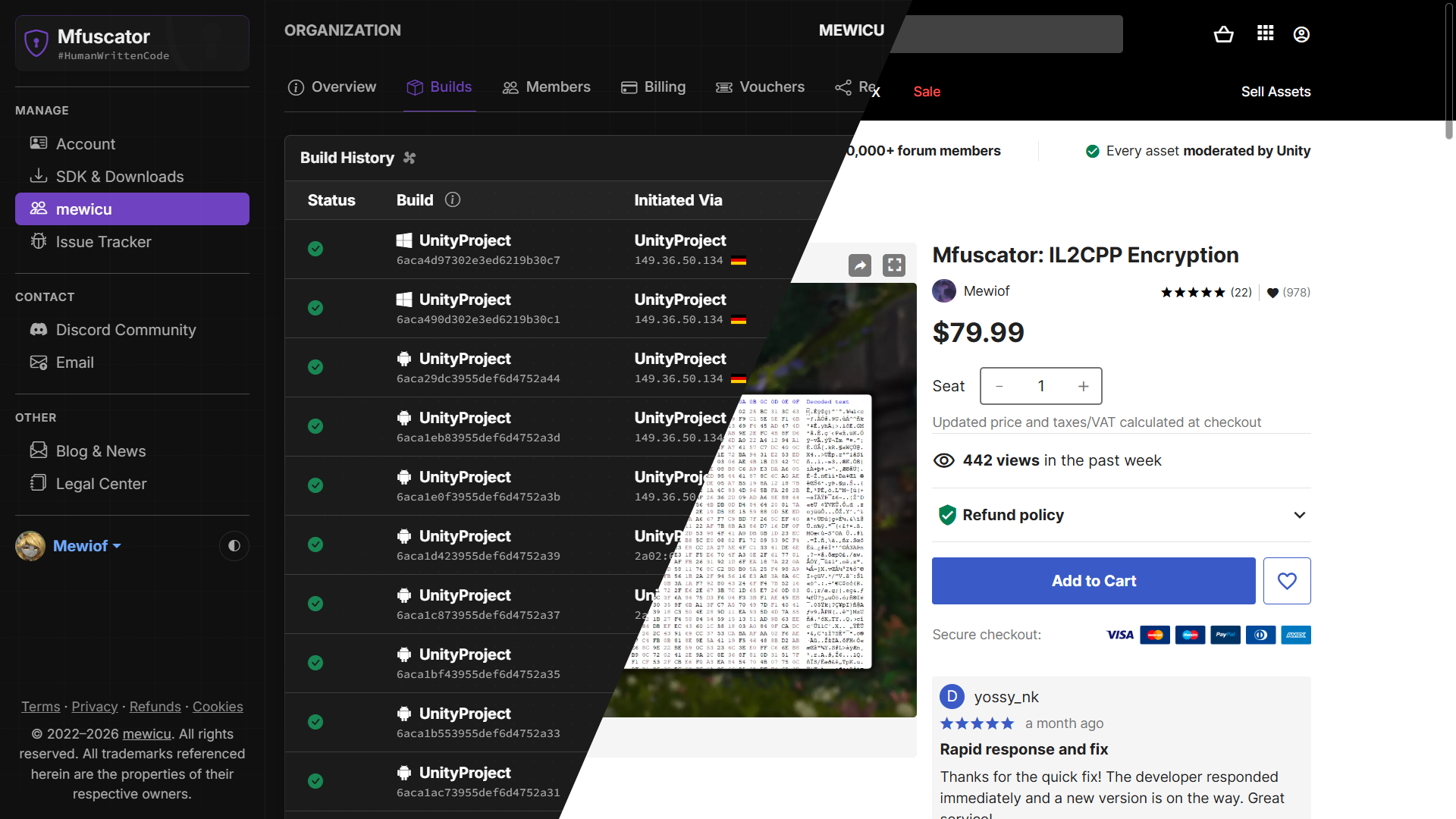
2. Protect the IL2CPP output. This is what Mfuscator does. You get:
- Encrypted metadata. Every metadata table is encrypted (class/method/field names and string literals included) and moved into the game binary. The structures Il2CppDumper looks for are hidden. The dumper has nothing to read, so the AI workflow above has no names to start from.
- Virtualized and mutated engine code. The code that decrypts the metadata at startup is converted by HV into a custom instruction set (run by interpreters generated fresh for each build). Other engine functions are mutated (rewritten into equivalent machine code that is much harder to follow).
- A different engine every build. The IL2CPP runtime changes per build (exports hidden or relocated/internal structure layouts randomized/identifying strings removed). Tools and signatures written against stock Unity don't line up.
- New keys every build. Keys/layouts/interpreters change each time you build.
- Anti-injection. Blocks mod loaders (MelonLoader/BepInEx) and debuggers (the usual way into a running game to dump it).
3. Protect demos and playtests first. The demo is the one anyone can download for free. In this story it's the one that got copied. Protect every build that leaves the studio.
4. Keep your evidence. Keep your version control history and archive every public build with its date. If a copy turns up, a takedown goes faster when you can show your code existed first.
What protection doesn't do. It doesn't make a game impossible to reverse engineer (a skilled person with enough time can still work through a protected build). It can't stop a clone built from a trailer. What it changes is the cost. Copying a protected demo means real reverse engineering work rather than a few hours with Claude. A cloner racing your launch rarely has time for that.
Common questions
Will it slow my demo down? The cost is mostly at startup (from setting up the virtual machines). Frame rate during gameplay is unaffected. You can tune the interpreter count and complexity in the SDK window.
Is my source code uploaded? No. Only the compiled build output is sent. Your Assets folder and project files never leave your machine.
Can AI tools read a protected build? They can read native code the same way a person with a decompiler can (only faster). There are no names or strings to start from on a protected build. The code that decrypts them is virtualized (the keys change with every build). That converts minutes of AI work into a long reverse engineering job. Most of it has to be redone for each new build.
Shipping a demo soon?
Protect that build before you upload.
The good news
A lot of what makes a game work can't be lifted out of a build.
A multiplayer game needs players. A clone launches with empty lobbies, and people play where their friends already are. The same goes for any game built around a community (mods/servers/a Discord that's been busy for months).
Clones are always behind. A clone starts from a game that already exists, so by the time it ships, the original has had weeks of updates/feedback/word of mouth. Players are noticing too: they're asking Valve for an AI filter. Outlets are calling out clones.
AI is bad at being original. Ask a model for "a game like this" and it tends to give back the most typical/generic/average version of it (part of why so many AI-made Next Fest games look alike). The odd, specific/artistic choices that make a game feel like its own are what it currently struggles with. That may change, but for now those still come from people.
So if you're making something with its own ideas in it, keep making it.
We believe that what is happening is extremely sad, disheartening, and simply unfortunate. We wish that LLMs had never existed and were technically impossible. We support the human developers and are trying to stay optimistic as we observe the situation and adapt to it. If you have a story to share or if you’d like just to chat, share your thoughts/vision on things - join our Discord community or email us ([email protected]) directly.
Thank you for trusting Mfuscator to protect your hard work.